Fitting the wrong chain is expensive in a quiet way: it looks right, runs for a while, and then wears the sprocket, jumps under load, or simply will not fit over the teeth. Before you can quote, replace or cross-reference anything, you need one thing — the exact model. There are only two ways to get it: read the marking, or measure the chain.
Step 1 — Look for the stamped marking
Most chains carry their model stamped or laser-marked on the outer side plates, usually within the first few links from the connecting link. On a new chain it is easy to find. Typical markings look like this:
- 08B-1 — B series, size 08, single strand
- 16B-2 — B series, size 16, duplex
- 40-1 — A series (ANSI 40), single strand
- C2082H — double-pitch conveyor chain, heavy duty
The code is not random. Read it in three parts:
- The number sets the size — 08, 16, 40, 60. It is tied to the pitch.
- The letter tells you the series. A follows the ANSI B29.1 series (the 40 / 50 / 60 numbering familiar in North America), B follows ISO 606 / DIN 8187 (the 08B / 16B numbering used in Europe and most of Asia).
- The suffix gives the strand count: -1 simplex, -2 duplex, -3 triplex. No suffix usually still means single strand.
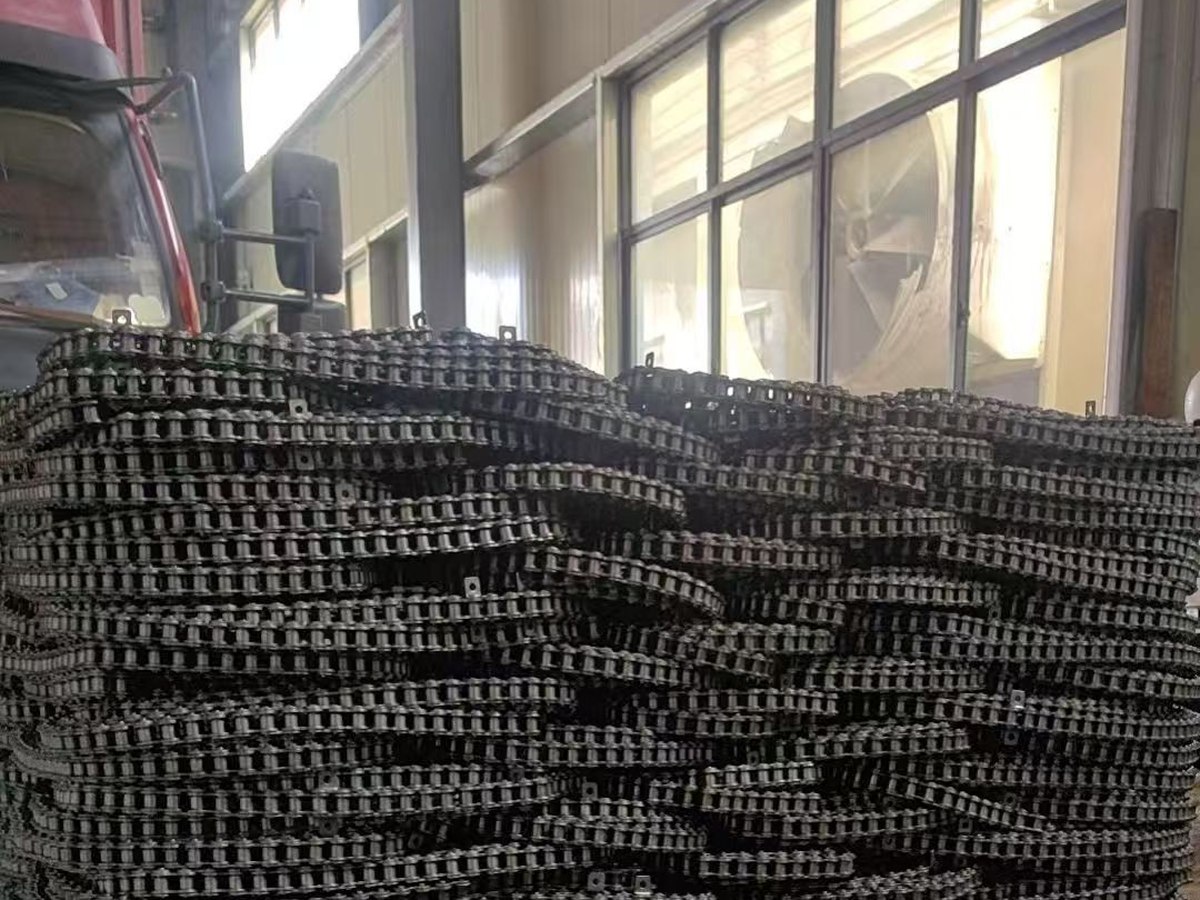
That is the easy case. The problem is that on a chain that has been running for years, the marking is often unreadable — polished away by wear, buried under rust, painted over, or, on low-cost chain, never stamped in the first place. This is where most people get stuck.
Step 2 — Measure it properly
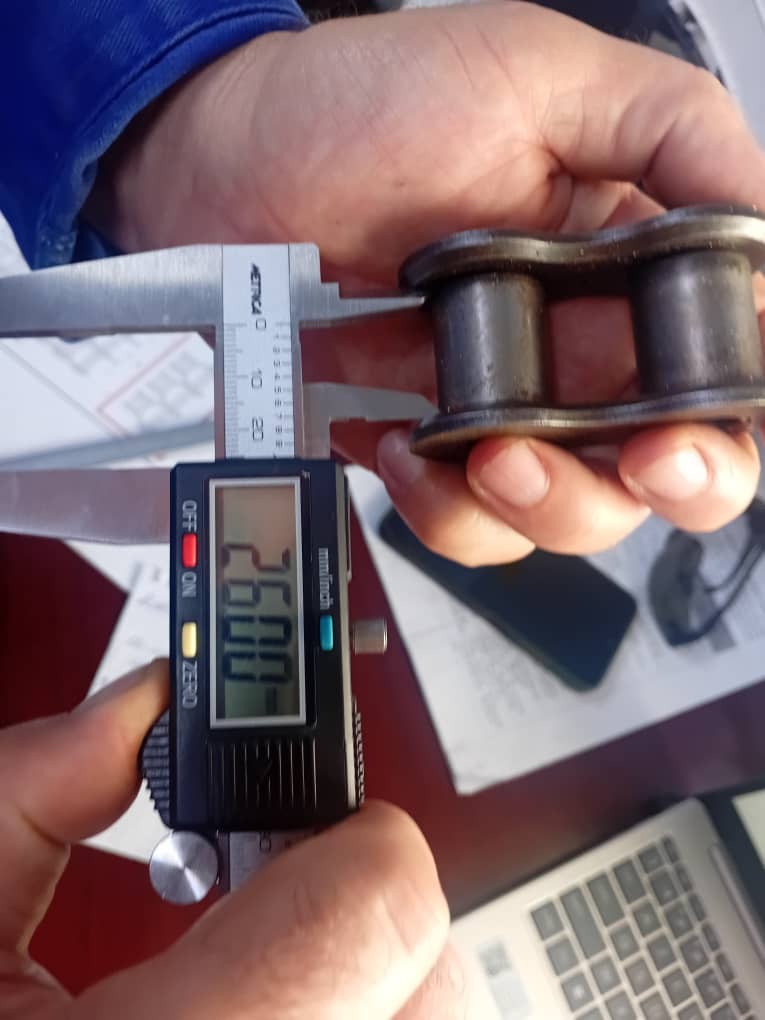
You need a digital caliper that reads to 0.01 mm (or 0.001 in) and, ideally, a steel rule. Two habits make the difference between a measurement you can quote from and one you cannot:
- Measure on a clean, straight section. Not at a worn joint, not at a seized pin, not across a bent plate.
- Take three readings in different places and use the average. A worn chain varies along its length — that variation is itself useful information.
Pitch (P) — the dimension that decides everything
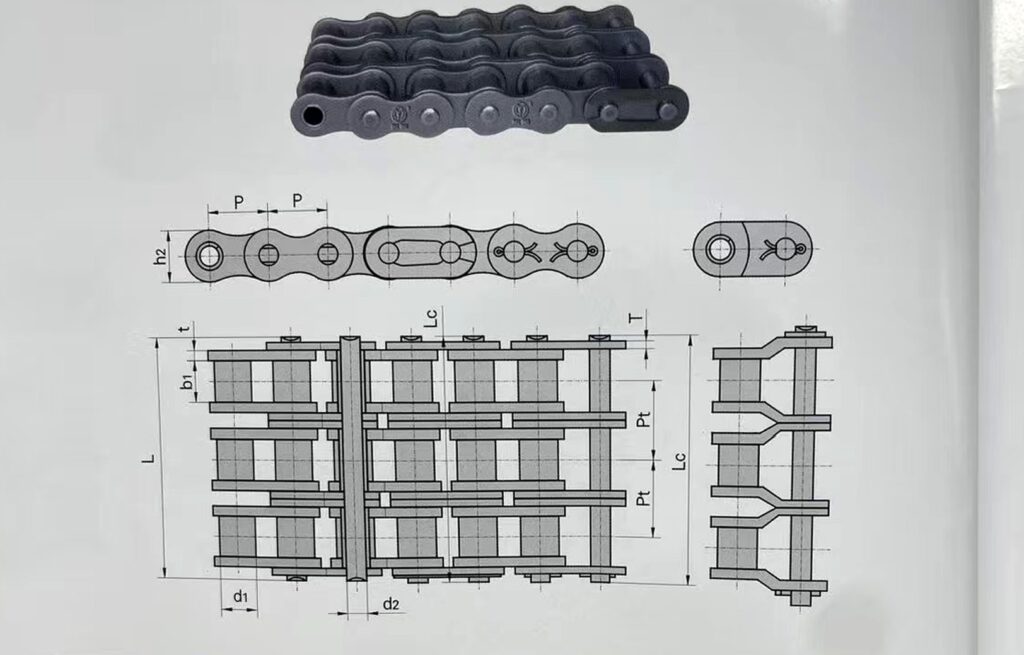
Pitch is the centre-to-centre distance between two adjacent pin centres. It is the single most important number on a roller chain: it fixes the size, it has to match the sprocket, and it is the first column of every chain table.
On a used chain, do not measure a single pitch — wear and play will inflate the number and you will end up one size too big. Measure across ten pitches (or five, if the chain is short) and divide by ten. That averages the error out and gives you a figure you can compare directly against a catalogue.
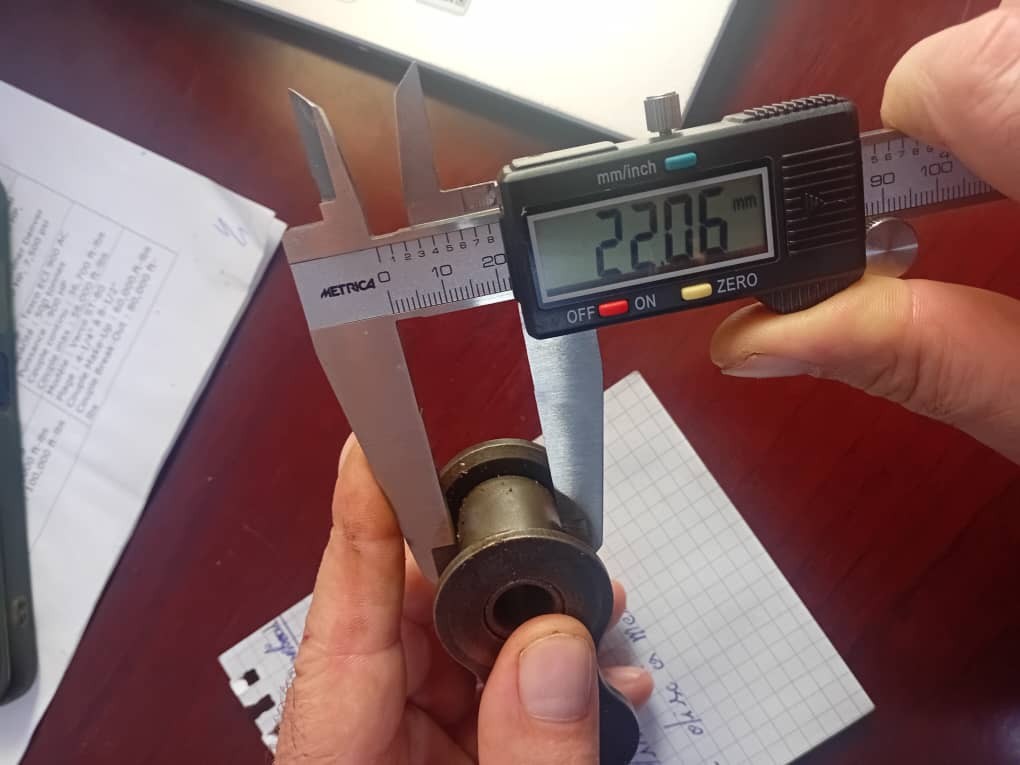
Roller diameter (d1) and inner width (b1)
Pitch gives you the size number. It does not tell you whether you have an A series or a B series chain — and this is the most common identification mistake we see. Take size 08: both 08A and 08B have a 12.700 mm pitch, but the roller is 7.92 mm on the A series and 8.51 mm on the B series.
So you also need:
- Roller diameter (d1) — across the outside of the roller, measured at the middle of the roller, not at a worn flat.
- Inner width (b1) — the clear gap between the two inner plates. This is the slot the sprocket tooth runs in, and it is what stops an A series chain from sitting correctly on a B series sprocket.
Pin diameter (d2), plate height (h2) and plate thickness (T)
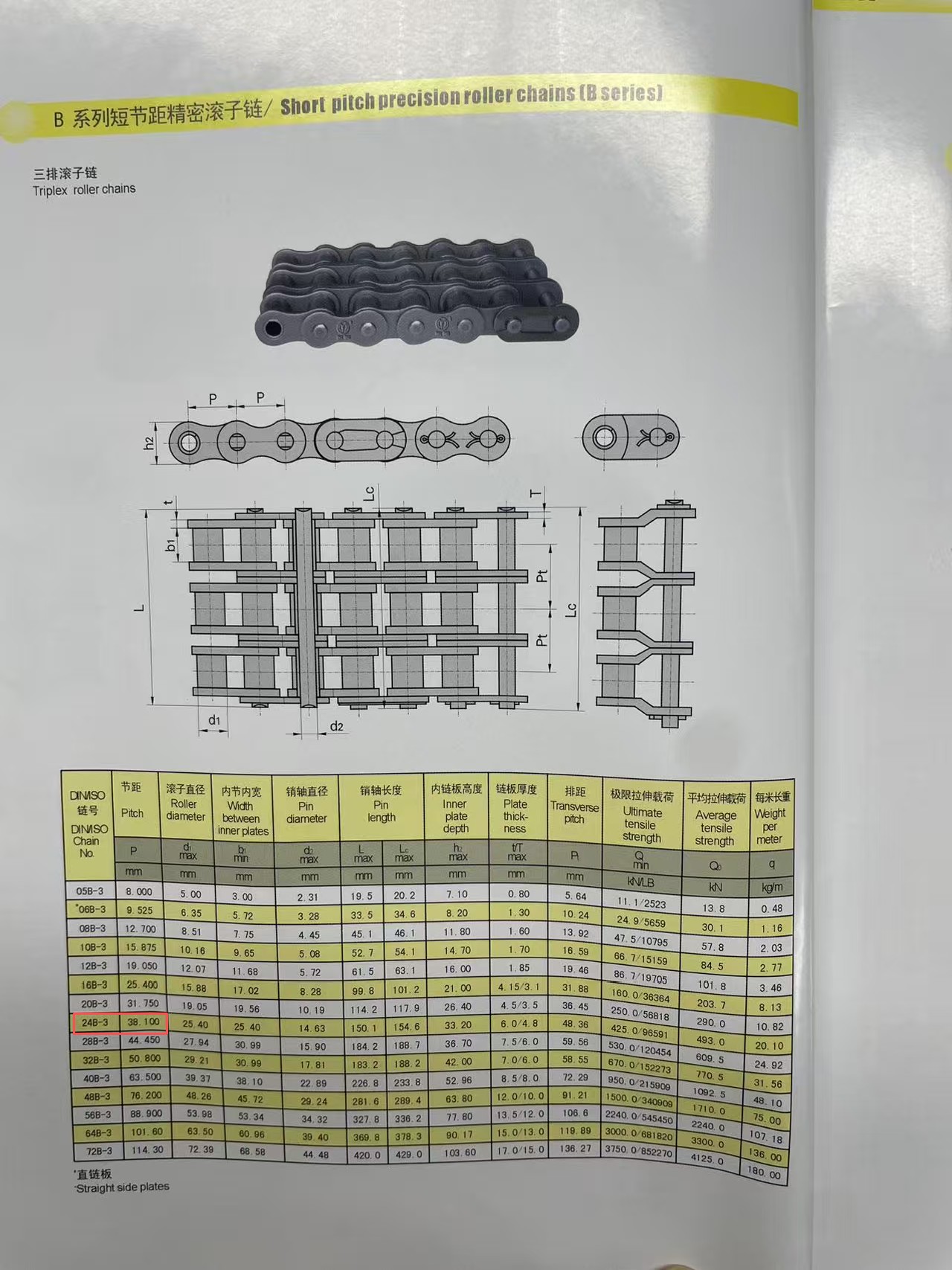
These three are your cross-checks. If the roller is worn oval and d1 is unreliable, the pin diameter and plate height still separate the series. Plate thickness is also how you tell a standard chain from a heavy-duty one: the heavy-duty version of the same pitch carries thicker plates and a higher tensile strength.
Count the strands
Finally, count how many rows of rollers sit side by side: one is simplex, two duplex, three triplex. On multi-strand chain also note the transverse pitch (Pt) — the distance between the centre lines of adjacent strands — because two chains with the same pitch and the same strand count can still differ there.
Step 3 — Match the measurements against the catalogue
With pitch, roller diameter, inner width and strand count in hand, identification becomes a lookup. Compare the measured pitch against the size number first, then confirm the roller diameter and inner width, then read off the part number.
The table below shows why pitch alone is not enough. Every row shares the same pitch across both series — the roller diameter is what tells them apart.
| Pitch P (mm) | A series (ANSI) | d1 roller (mm) | B series (ISO/DIN) | d1 roller (mm) |
|---|---|---|---|---|
| 12.700 | 40 / 08A | 7.92 | 08B | 8.51 |
| 15.875 | 50 / 10A | 10.16 | 10B | 10.16 |
| 19.050 | 60 / 12A | 11.91 | 12B | 12.07 |
| 25.400 | 80 / 16A | 15.88 | 16B | 15.88 |
| 31.750 | 100 / 20A | 19.05 | 20B | 19.05 |
| 38.100 | 120 / 24A | 22.23 | 24B | 25.40 |
| 50.800 | 160 / 32A | 28.58 | 32B | 29.21 |
Read it carefully and you will see the trap: at sizes 10, 16 and 20 the roller diameter is identical between series. There the difference sits in the inner width and the plate height — 10A is 9.40 mm wide inside, 10B is 9.65 mm. A chain identified on pitch and roller alone can still be the wrong series.
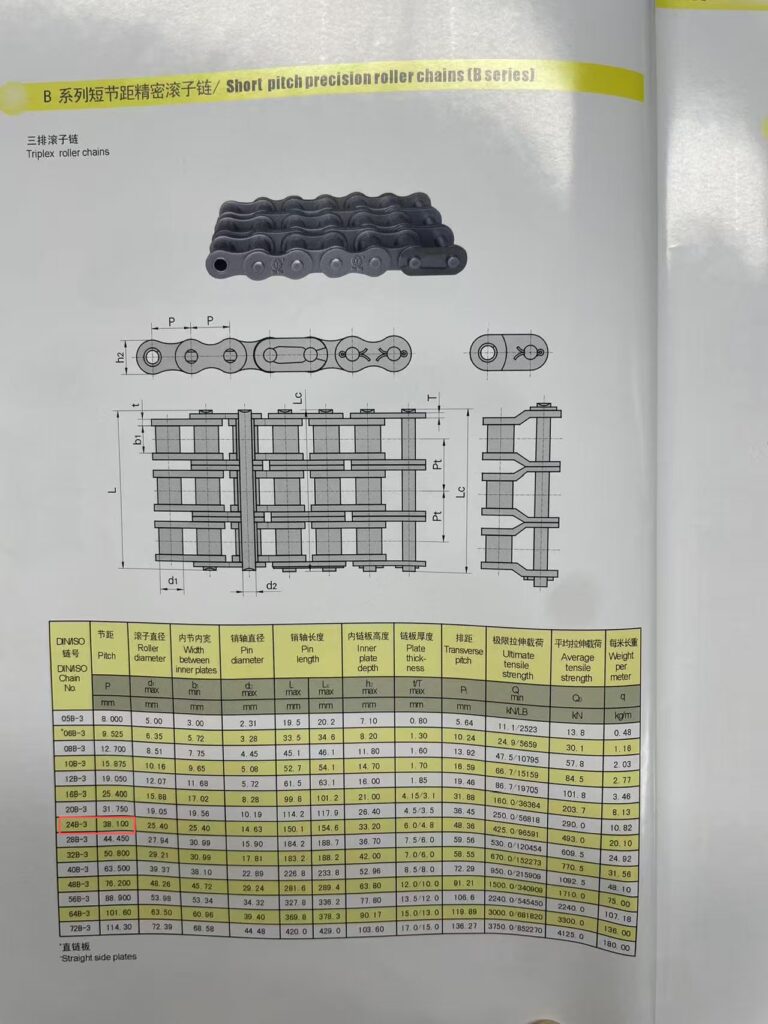
Our full dimension tables — pitch, roller diameter, inner width, pin diameter, pin length, plate height, plate thickness, ultimate tensile strength and weight per metre — are published for both series in the UIB Chain catalogue (PDF). The standard roller chain families are also listed on the site:
- Industrial roller chain — A and B series, single and multi-strand
- Universal chain — the common sizes kept in stock
Step 4 — When nothing matches, it is probably custom
Sometimes the numbers simply do not land on any row. The usual reasons:
- The chain has worn so far that the pitch is no longer reliable, and the plates are polished smooth.
- It is a modified or non-standard chain — altered pitch, special plate, a purpose-built attachment.
- It is an obsolete or discontinued standard, common on older imported machinery.
- It is an attachment chain where the plate geometry is doing the real work, and the chain body is only half the story.
That is not a dead end. It is the point where you send it to a manufacturer rather than a catalogue. We produce custom roller chains and the matching sprockets — special pitches, non-standard plate shapes, welded and bent attachments, stainless and high-temperature variants — and we cut the sprocket to the same drawing so the pair actually runs together.
Send us three numbers and a photo. Pitch, roller diameter, inner width — plus how many strands and what the chain drives. If it is worn beyond measuring, send the sprocket instead: we can work back from the tooth profile.
Quick recap
- Look for the stamping on the outer plates — read number, letter, suffix.
- Measure pitch across ten pitches and divide, then roller diameter and inner width.
- Check the strand count, and transverse pitch on multi-strand chain.
- Match against the dimension table — if two rows fit, inner width decides.
- Ask if nothing matches. Custom is a normal answer, not a failure.