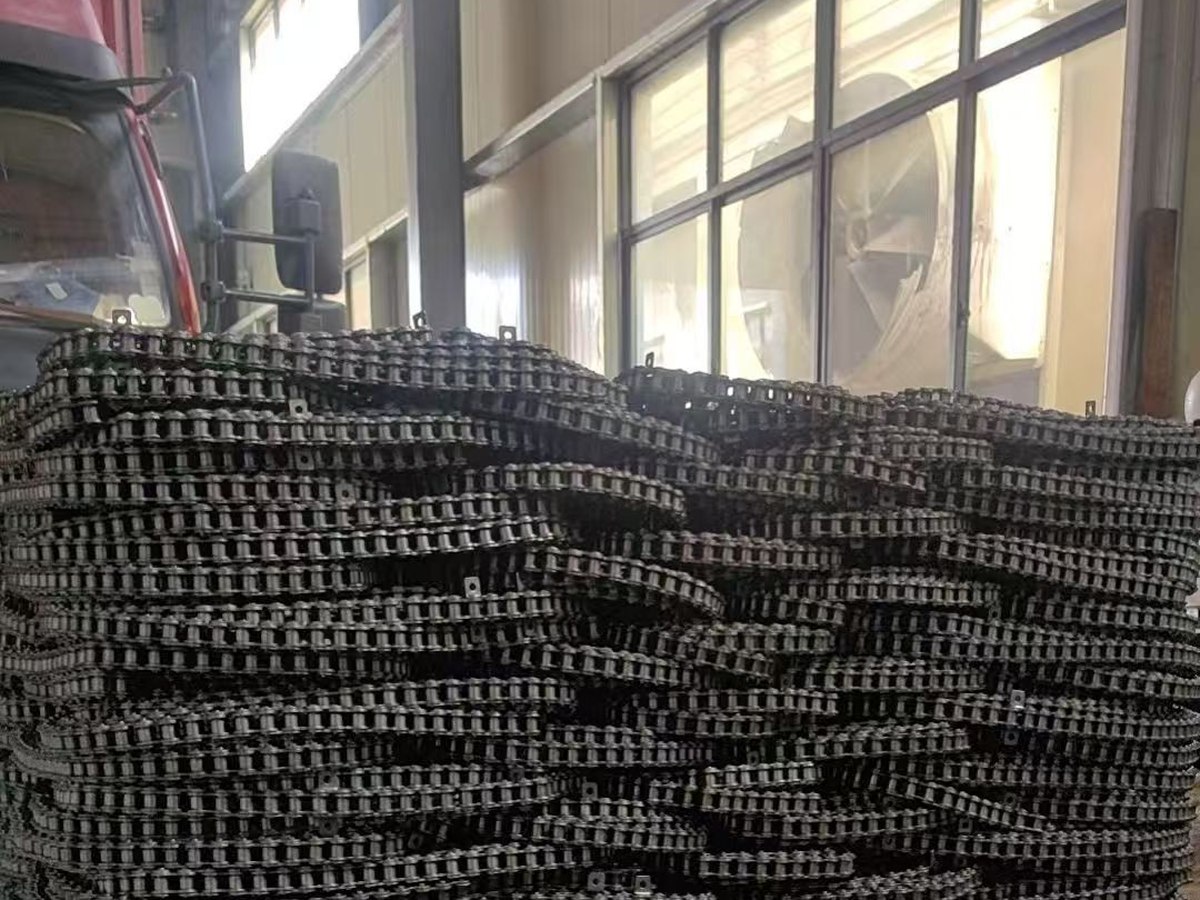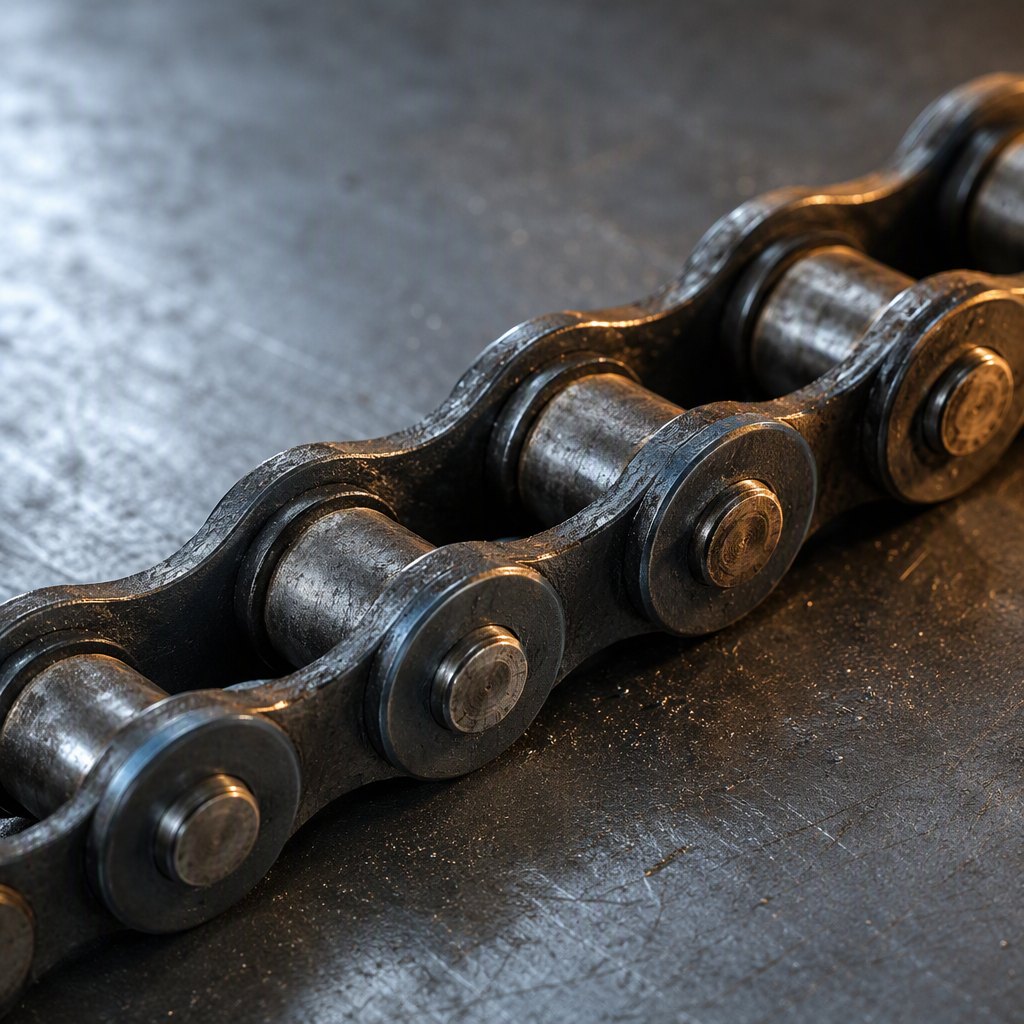
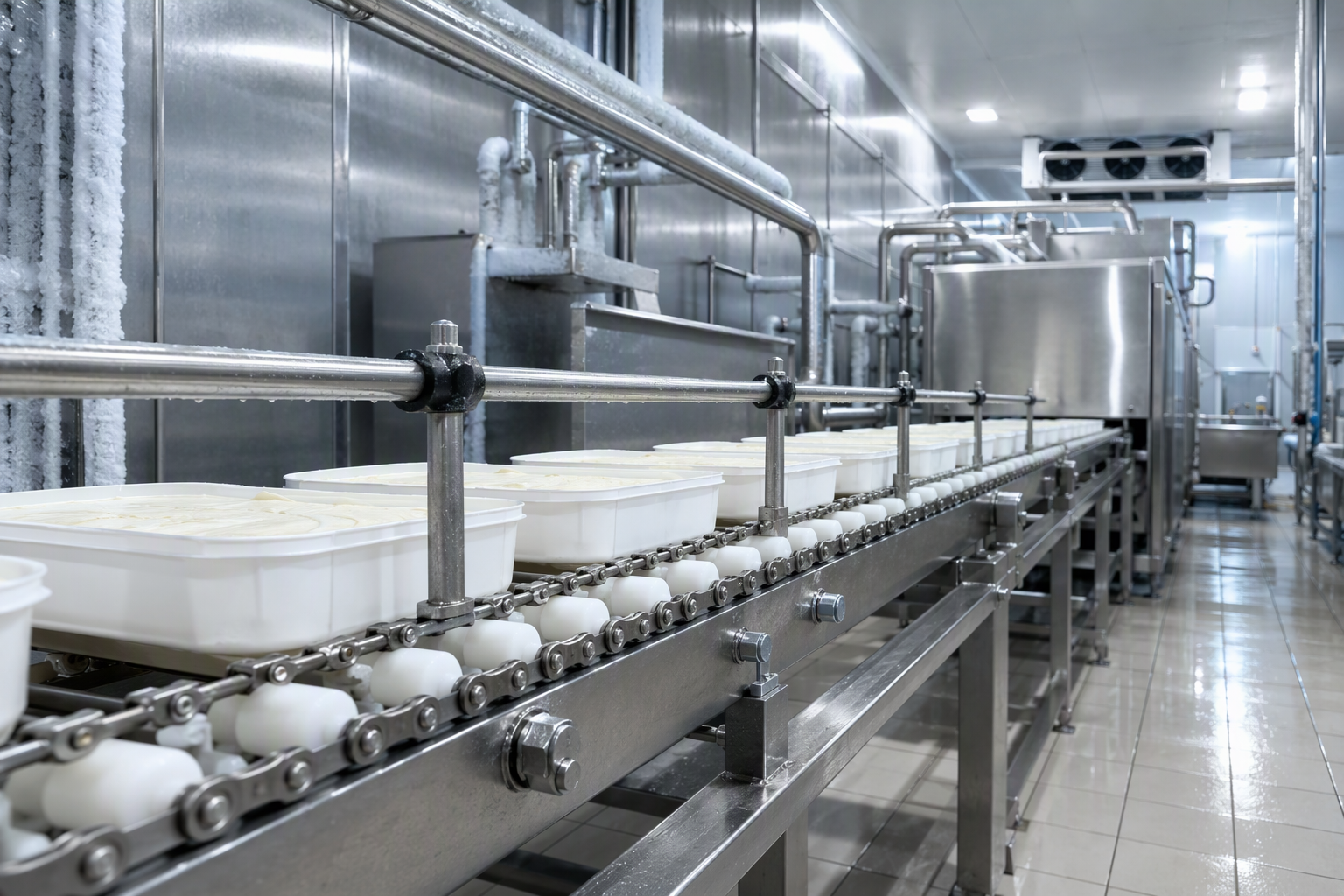
Frozen food and ice cream lines are one of the few places where a roller chain is asked to run all day in a room colder than the product it carries. The chain is a small part of the conveyor cost, but when it fails the line stops — and in a cold store a stop usually means product loss as well. These are the decisions that most affect chain life on a cold chain conveyor, and the details worth writing into a specification before the order is placed.
Why a standard roller chain struggles below zero
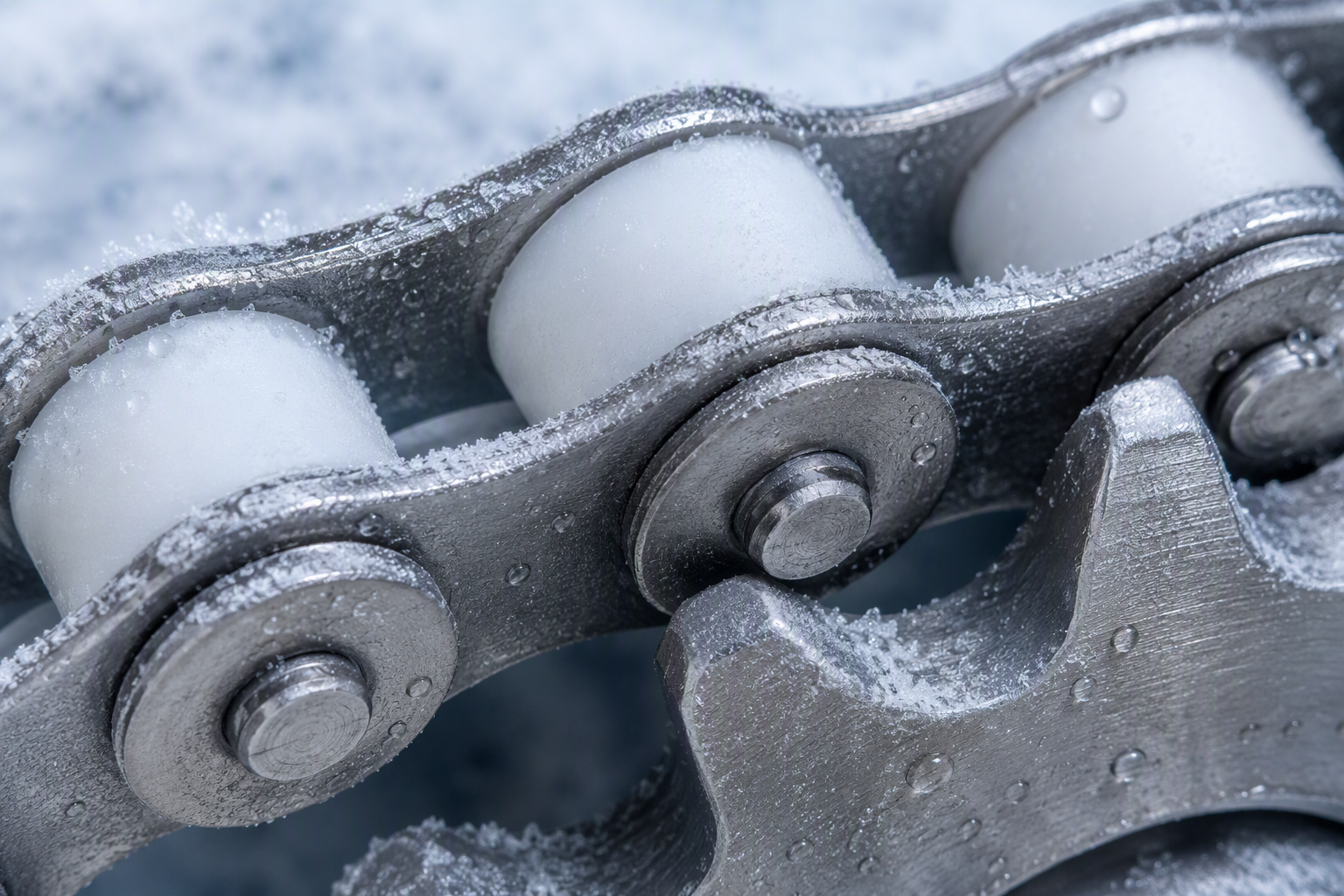
A carbon steel chain that runs well in a dry workshop behaves differently in a freezer. Moisture condenses on the chain every time it passes a door, then freezes. Ice bridges form between the link plates and the rollers, and the chain stops articulating freely. Standard grease thickens at low temperature, so it no longer reaches the pin and bush. Wear then moves from the roller to the pin and bush, and tight links appear long before the rollers look worn.
Material choices that decide service life
Two material decisions carry most of the outcome. Link plates and pins in stainless steel remove the corrosion path that condensation creates: 304 covers most cold store and wash-down duty, while 316 is reserved for salt or aggressive cleaning chemicals. Rollers in white polymer rather than steel do three things at once — they do not rust, they do not mark product contact surfaces, and they run quieter on stainless track. For food lines this is usually the combination to specify: stainless plates, polymer rollers.
Configuration details worth specifying
- Open hinge structure — cleaning solution and water drain away instead of sitting inside a closed joint.
- Protruding or grooved pin ends — flights, brackets and pushers can be mounted without welding on the line.
- Hollow pins — where a cross rod or product carrier has to pass through the chain.
- Uniform roller spacing — keeps product transfer smooth and spreads load evenly along the run.
- Single or multi-strand — multi-strand sets for wide belts and heavier trays.
- Length cut in pitches — chain is ordered by link count, not by metres.
Matching the chain to the duty
| Duty | Configuration to specify |
|---|---|
| Frost-free cold store, light product | Stainless plates, white polymer rollers |
| Heavy condensation or wash-down | 304 stainless, open hinge, polymer rollers |
| Wide belt, heavy trays | Multi-strand stainless set with attachment pins |
| Product carried between two runs | Hollow pin double pitch chain |
| Salt or aggressive chemicals | 316 stainless |
Sizing before you order
Chain is specified by pitch and by link count. Measure the pitch across several links and divide, rather than measuring a single link — one link measured alone includes the roller diameter and gives a number that will not match any catalogue. Check the sprocket at the same time: a chain with the right pitch but the wrong roller diameter will not seat correctly, and ANSI and ISO chains of the same pitch are not interchangeable. Finally, allow for take-up: a run specified to the exact centre distance leaves no room to tension the chain as it wears.
Maintenance on a frozen line
Most cold chain chain failures are visible before they happen. After every defrost cycle, check for ice bridging between plates and rollers, and clear it before the chain runs again. Look for tight links when the chain is cold, flat spots on rollers, and elongation measured over a fixed number of pitches. Lubrication has limits at low temperature — where a food line cannot tolerate lubricant, the practical answer is a stainless and polymer chain that is designed to run dry rather than a chain that is relubricated less often. When the chain is replaced, check the sprockets: a worn sprocket will destroy a new chain in a fraction of its expected life.
UIB manufactures stainless steel roller chains with white polymer rollers, attachment pin chains and hollow pin double pitch chains for cold chain conveyors. See the cold chain conveyor chain range, or start from the white roller conveyor chain and the C2062HP hollow pin double pitch chain. Send us your pitch, link count and duty and we will confirm the configuration.